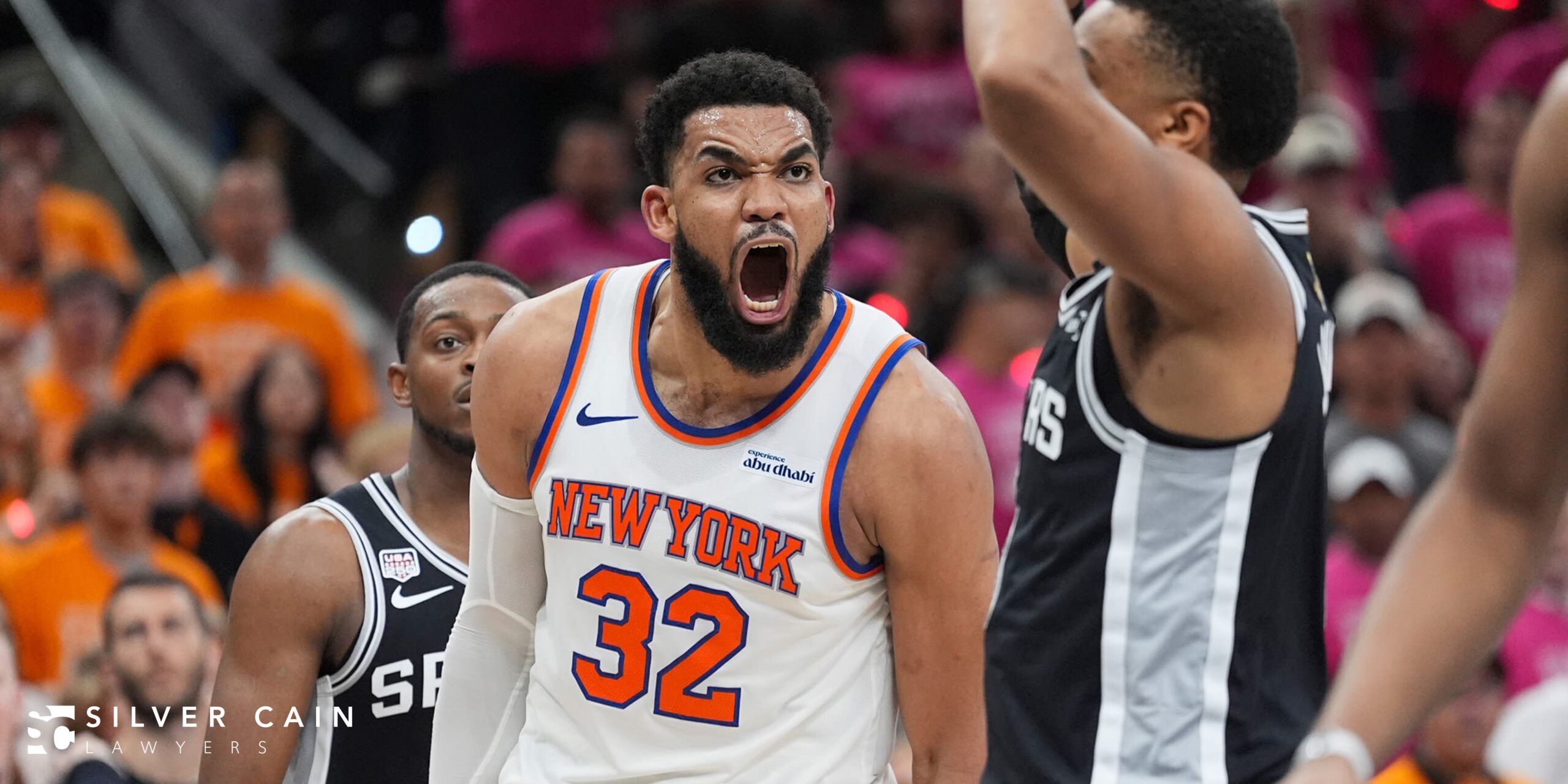
I have been a New York Knicks fan my entire life, which means I have spent most of that life learning patience the hard way. Last night, in Game 4 of the NBA Finals at Madison Square Garden, that patience was rewarded with something no basketball fan of any team has ever seen: the greatest comeback in NBA Finals history. And as I sat there watching it unfold, I kept thinking that what happened on that floor is exactly what it takes to win a trial.
Consider where the Knicks stood at halftime. The San Antonio Spurs had hit a Finals-record fourteen three-pointers in the first half and led 76-49 — in our building. The lead stretched to twenty-nine. No team had ever come back from more than twenty-four points down in a Finals game, and no team had ever erased more than a twenty-one-point halftime deficit — a record that had stood since 1948. By any rational measure, the game was over.
Except it wasn’t. The Knicks did not panic, and they did not try to get it all back at once. They chipped away — possession by possession, stop by stop — until, with 1.2 seconds left, OG Anunoby crashed in from the three-point line, tipped in Jalen Brunson’s missed shot, and the Garden exploded: 107-106, Knicks. Brunson finished with 36 points and 7 assists. Anunoby added 33, hitting 7 of 9 from three. Victor Wembanyama had 24 points and 13 rebounds for the Spurs, and it wasn’t enough. The Knicks now lead the series 3-1, one win away from their first championship since 1973.
Where I Come In: 1970 to 1973
That year — 1973 — matters to me personally. My first experience as a Knicks fan was watching the great teams of 1970 through 1973: Willis Reed, Walt Frazier, Bill Bradley, Dave DeBusschere, Dick Barnett, and later Earl Monroe, all coached by Red Holzman. Those teams won two championships, and they did it in a way that shaped how I think about teamwork to this day. Holzman’s mantras were simple: see the ball and hit the open man. Nobody cared who scored. Five future Hall of Famers shared the ball as if the extra pass were the whole point of the game — because, for them, it was. Willis Reed limping out of the tunnel for Game 7 in 1970 remains the most famous image, but what won those titles was unselfishness, intelligence, and trust.
Two decades later came the Knicks of the mid-nineties — Patrick Ewing, Charles Oakley, Anthony Mason, John Starks, with Pat Riley on the sideline. Those teams never had the most talent on the floor, but they were never out-toughed by anyone. Every game was a fistfight, every possession contested. They taught a different lesson: when skill is roughly equal, the team that refuses to fold wins.
What makes this current team special — and what made last night possible — is that they are a throwback to both. Brunson is a star who plays like a teammate. Anunoby’s game-winner happened because he kept working when everyone else was watching the ball. This team moves the ball like Holzman’s teams and absorbs punishment like Riley’s. Last night required both inheritances: the trust of 1973 and the toughness of 1994.
Every Trial Has a First Half Like That
If you have ever tried a case of any real length, you know the feeling of being down twenty-seven at the half. Every trial — every single one — involves enormous emotional swings. Your key witness gets dismantled on cross. The judge issues a ruling that guts a theory you spent a year building. Opposing counsel’s expert is better than you feared. The jury seems to be nodding along with the other side. There is a moment in nearly every trial when, if you looked only at the scoreboard, you would conclude the case is lost.
But trials, like basketball games, are not decided at halftime. Here is what last night’s game teaches about getting from down twenty-nine to a verdict in your favor.
The scoreboard at halftime is not the verdict. A devastating morning of testimony feels final in the moment, but juries judge the whole case, not its worst hour. The Knicks understood that twenty-nine points down with a half to play is a problem, not a conclusion. The lawyers who win trials are the ones who can absorb a terrible day and walk into court the next morning as if the score were tied — because, in the only tally that counts, it still is.
Believe in yourself, your team, and your case. Down twenty-nine, the Knicks did not abandon their identity or start chasing the deficit with hero ball. They kept running their offense and trusted that the shots would fall. The same is true at trial. If you prepared properly — if you believed in the case when you took it and built it honestly — one bad afternoon does not change the merits. Panic is what turns a deficit into a final score. The moment you abandon your theory of the case mid-trial because of a bad stretch, you have done to yourself what the other side could not.
Preparation is what makes belief rational. Comebacks look like miracles from the stands. They are not. They are conditioning, film study, and ten thousand repetitions showing up when it matters. The trial equivalent is knowing the record cold — so cold that when the surprise comes, you can pivot without flinching. Confidence that is not built on preparation is bravado, and juries can smell the difference.
Win one possession at a time. The Knicks did not erase twenty-nine points with one shot, and you will not rescue a struggling case with one dramatic cross-examination. You chip away: the next witness, the next exhibit, the next objection, the next small moment of connection with the jury. Momentum in a courtroom is built exactly the way it is built on a basketball floor — incrementally, until suddenly the whole room can feel it shifting.
Hit the open man. Brunson took the final shot, but the game was won by the teammate who crashed the glass. Red Holzman would have loved it. In a trial, trust your team the same way — let your second chair take the witness she knows better than you do, listen to the paralegal who has lived in the documents for two years. The cases I am proudest of were won the way the 1973 Knicks won: everybody touching the ball.
Play to the buzzer. The winning basket came with 1.2 seconds left, off a missed shot, because one player treated a possession everyone else thought was over as if it were still alive. Trials turn on the same instinct — the final argument over jury instructions, the rebuttal point you almost left out. The case is never over until the verdict is read.
Fifty-Three Years Is a Trial
If the Knicks win one more game, it will be their first championship in fifty-three years. I was there — in front of a television, as a kid — for the last one. In the fifty-six years since I started watching, I have seen virtually every Knicks playoff game played: the triumphs of the early seventies, the wars of the nineties, and everything in between. There have been heartbreaks, false starts, and decades when believing felt foolish. That, too, is part of the lesson. Resilience is not a halftime speech; it is a way of working, sustained over a very long time, by people who trust each other and refuse to quit.
Whatever your version of down twenty-nine at the half looks like — in a courtroom, a boardroom, or a season — last night at the Garden is proof of what preparation, belief, and relentless execution can do. See the ball. Hit the open man. Play to the buzzer.
A Word About Silver Cain
Silver Cain PLC was founded on the premise that businesses deserve both exceptional litigation experience and direct partner access — and that you should not have to choose between them. Leon Silver and Rebecca Cain have spent decades handling the most complex business and real estate disputes in Arizona and nationally. If you are evaluating counsel in Phoenix, we welcome the conversation.