
There is a rare and specific pleasure in a rule you can follow so faithfully that it collapses under its own weight. Retired Judge James Smith handed me one recently — or, more precisely, he posted one. On his page he shared an anonymized standing order now making the rounds:
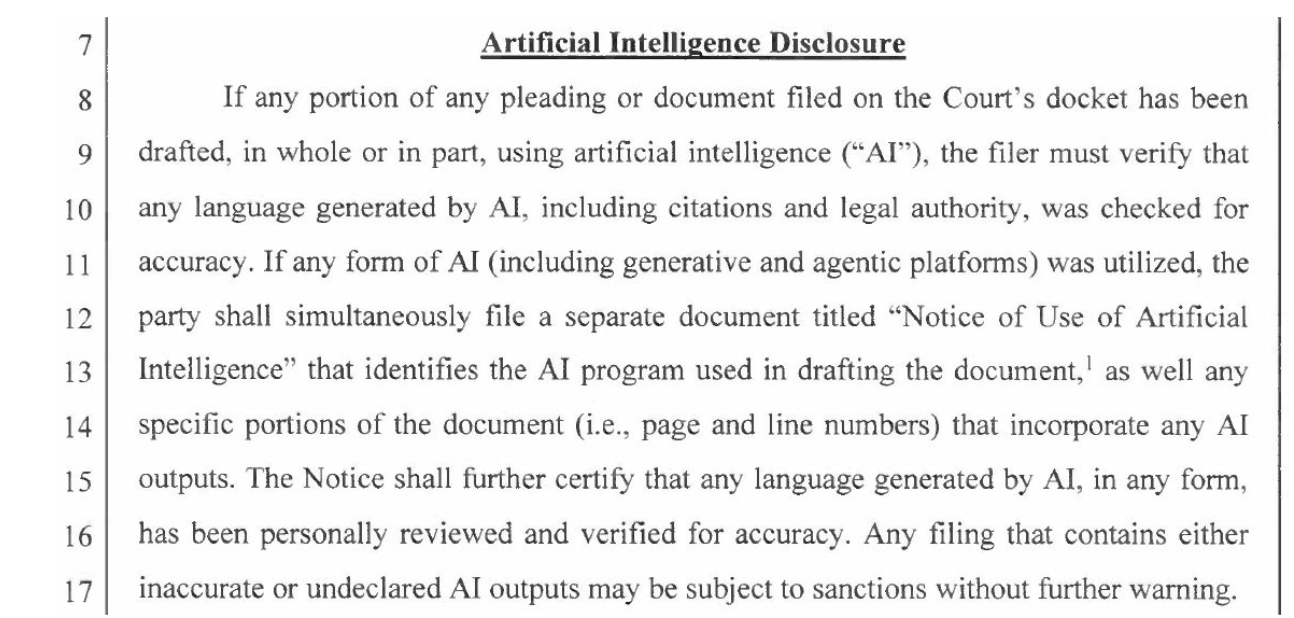
Judge Smith didn’t endorse it; he asked the right question: can the pendulum swing too far in combatting the improper use of AI? It can — so rather than argue the point, I decided to prove it through malicious compliance. And in the interest of brevity, I only take it as far as the caption: no argument and no facts, nothing anyone has ever been sanctioned over — and attempt to disclose every point at which AI, in any form, touched it:
IN THE SUPERIOR COURT OF THE STATE OF ARIZONAIN AND FOR THE COUNTY OF MARICOPA
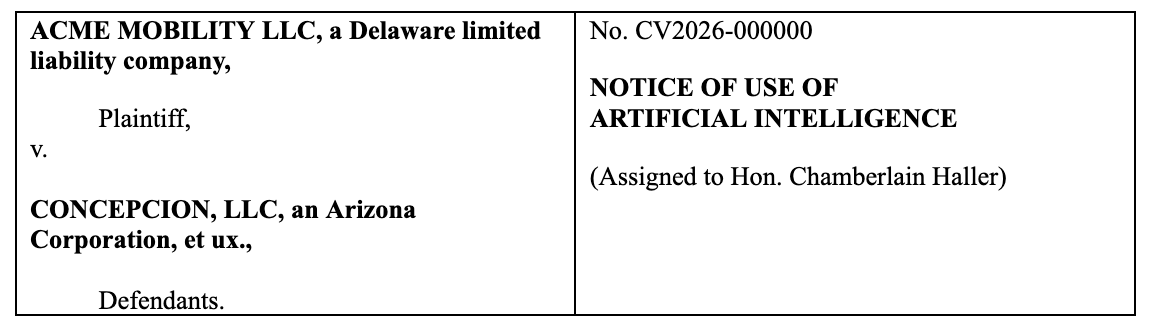
Pursuant to this Court’s Standing Order on the Use of Artificial Intelligence, Plaintiff hereby submits this Notice of Use of Artificial Intelligence and discloses each instance in which artificial intelligence — generative, agentic, embedded, predictive, or ambient — touched the above-captioned filing.
I. The Caption
1. Caption, line 1 (court designation). An AI-assisted legal-research query was used to confirm that the Commercial Court of the Maricopa County Superior Court is the correct designation and that the matter had not been assigned to the Hon. Chamberlain Haller, sitting by designation. The tool’s answer was independently verified.
2. Caption, line 2 (“Acme Mobility LLC”). An AI-assisted search of Delaware corporate records confirmed that the entity is properly denominated an LLC, is organized in Delaware, and sits four levels down a corporate-parentage chain irrelevant to this caption. Separately, predictive text on undersigned counsel’s word processing program autocorrected “LLC” to “LOL.” The autocorrection was rejected but is disclosed, as it is, technically, AI output that touched the document.
3. Caption, line 3 (“Concepcion”). Browser spellcheck flagged the name as a probable misspelling of “Conception.” An AI-powered search confirmed the spelling as filed. The suggestion was rejected; the confirmation was adopted and disclosed. AI further confirmed that Concpecion is a corporation duly organized and existing under the laws of the state of Arizona.
4. Caption, line 3 (“et ux.”). A grammar assistant underlined the phrase and proposed “et al.” The proposal was incorrect and was rejected. The Order does not ask whether the assistant was right, only whether it touched the page.
5. Caption, forum and jurisdiction. An AI research platform advised that the matter “belongs before the United States Federal District Court for the District of Arizona” on the basis of diversity jurisdiction and suggested removal to the Ninth Circuit Court of Appeals; it did not recognize that removal is effected to a United States District Court rather than a Court of Appeals, nor that the time to remove has long since passed. The advice was, in every respect, wrong, and was rejected. In the course of providing it, the platform surfaced three unrelated authorities that no party has cited.
6. Caption formatting and typeface. An AI chatbot identified the wrong typeface as the one required by the applicable formatting rule. The correct rule was independently confirmed. The erroneous suggestion is disclosed as a touchpoint.
7. Pre-filing research (the Court and opposing counsel). Before the caption was drafted, undersigned counsel’s proprietary research tool was used to perform background research on the defendant, the assigned judge and opposing counsel and her firm. None of this research appears in the caption or anywhere in the filing. It is disclosed here solely because the Order defines “AI output” without regard to whether the output shaped the document. Counsel notes, and preserves by the Reservation below, that this disclosure compels production of attorney work product — the tools counsel selected and the impressions counsel formed — to the opposing party, who can read this docket.
8. Ambient artificial intelligence. While the filing was typed, the operating system, email client, calendar assistant, and search homepage on counsel’s computer each generated AI output — a mistitled calendar reminder among them — none of which touched the filing, all of which were present on screen. The Order drawing no line between AI that shaped the document and AI that was merely in the room, so it is disclosed.
Reservation. Paragraph 7 is submitted under protest. Counsel does not concede that the Order may compel disclosure of privileged attorney work product, and provides that portion of this Notice solely to avoid the sanctions the Order threatens “without further warning.”
Certification. The undersigned certifies that every instance of AI output identified above has been personally reviewed; that no fabricated or unverified legal authority appears in the caption; and that the caption is, to the best of counsel’s knowledge, correct. The undersigned further certifies that this Notice was itself prepared with the assistance of artificial intelligence, and that a Notice of Use of Artificial Intelligence in Connection with the Notice of Use of Artificial Intelligence will follow in due course.
RESPECTFULLY SUBMITTED
That is a full-page court filing generated by four lines of caption: no argument, no statement of facts, nothing anyone has ever been sanctioned over. The Notice is longer than the thing it describes. And read the last line of the certification: because the Notice was itself drafted with AI, it now requires a Notice of its own. It is disclosures all the way down.
The Point of the Exercise
Judge Smith flagged the right question to ask before every court in the country starts drafting its own version of this disclosure order. An order that treats an AI spellcheck suggestion the same as a fabricated citation isn’t protecting the integrity of the record. It’s asking lawyers to build a chain-of-custody log for autocomplete.
The irony is that the underlying concern — lawyers filing hallucinated authority without checking it — is already fully covered by existing duties. We didn’t need a new disclosure regime to tell lawyers to verify their citations; we needed lawyers to actually do it, and courts willing to sanction the ones who don’t. An order this broad doesn’t add protection at the level that matters. It adds paperwork at the level that doesn’t — and someone is billing the client for the time it takes to certify a caption.
If a rule can be complied with in a way that makes it look ridiculous without violating a single word of it, the rule is the problem, not the lawyer following it.
A disclosure form for autocomplete doesn’t stop anyone from filing fake case law. It just gives everyone something to point to afterward. If a rule this broad makes us feel like something is finally being done about hallucinated citations while doing precisely nothing about hallucinated citations, that’s the part where we’ve been fooled — and, ideally, the last time we let it happen.
A Word About Silver CainSilver Cain PLC represents businesses in complex commercial and real estate litigation in Arizona and beyond. When Rebecca Cain and I founded the firm, we built it around direct partner involvement, senior trial-level judgment, and a cost structure that passes the efficiencies of serious AI use through to clients rather than burying them in the leverage model. If questions about AI disclosure rules, supervision protocols, or practice management are relevant to your business — or to the firms you retain — we are glad to have that conversation.